


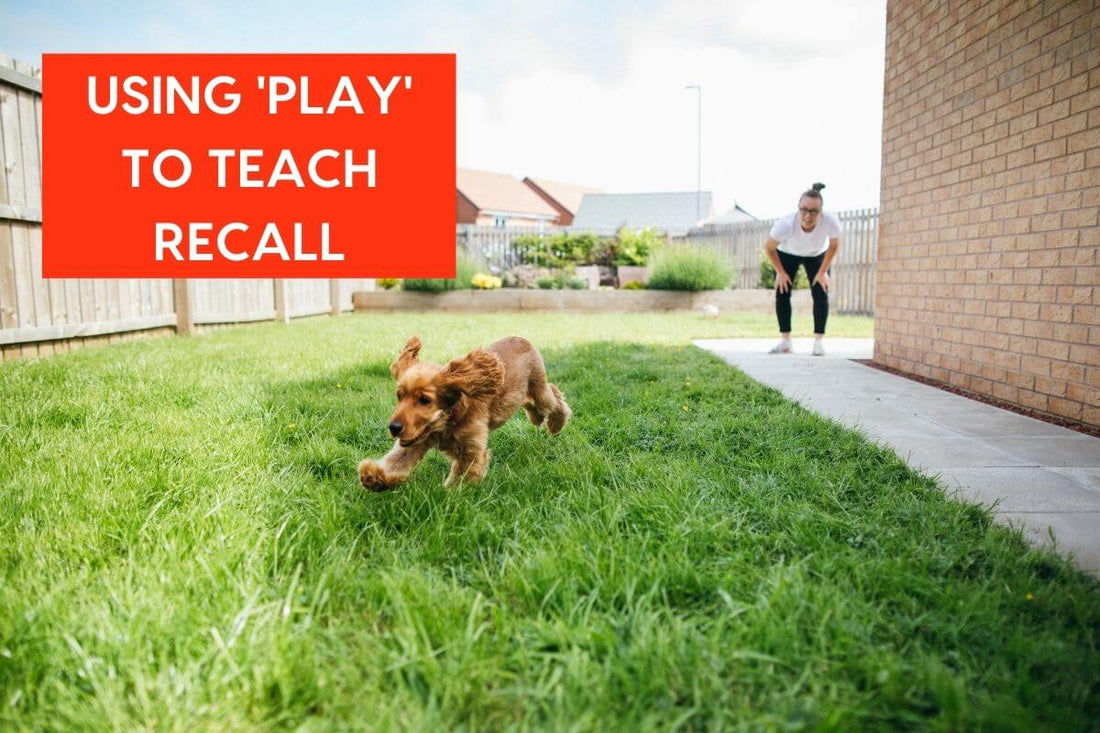
Recall (aka come when called) is vital for your dog's safety. Unfortunately, it can be one of the most difficult behaviors for dogs to really understand and grasp.
When working on recall with your dog (or other behaviors for that matter!) you want to find what reinforcements motivate your dog the most while training. While treats are generally the most widely used for training, some dogs just aren’t food motivated!
If that is the case for you, this is the podcast you need to listen to!
LISTEN TO PODCAST
Want to hear more podcasts like this? Please click here.
WATCH PODCAST
Want to see more videos like this? Please click here.
OVERVIEW OF USING 'PLAY' TO TEACH RECALL
One often under-used trick for teaching recall is to teach it with play. Yup, good old fun and games!
Scout (my Lab) is EXTREMELY ball-motivated. She loves all toys, but the ball is truly her life.
We struggled for years (honestly) to help her learn a solid recall because she just isn't that food motivated and we couldn't get her that interested in treats (no matter the treat) in high-distraction environments. The only thing she would focus on consistently while outside... her ball.
So, we decided to practice recall every single time we played fetch! Here is what we did, and what you can try!
- Start indoors in a controlled environment
- Throw the ball to your dog, then take 1-2 steps away from your dog (after they drop the ball) and call your dog to you (at first our dog Scout was slightly confused about that 'cue word' being introduced during play, but after a couple attempts she caught on).
- So, again... 1-2 steps back, call your dog to you. Once they come to you, quickly mark (we use 'yes') and then throw the ball.
- After practice inside, take it outside. Practicing this fetch-recall-training, every time you play fetch.
- Then, the same thing but at a park while on a 100-foot lead. Every 1-2 throws, you can have your dog do a come when called to get the ball.
And guess what, for us, it didn't magically improve overnight. Nope. It took about 6 months of practicing that almost every single day.
And now, she is almost perfect with recall.
The moral of the story... well there are 2.
1. Make recall (and all training) fun.
2. Find your dog's highest reinforcer and use that ALL THE TIME.
Need more ideas for recall training? Check out the 7 Day Recall Challenge, part of Pupford Academy +!


