


“If only my dog could talk!” I’m sure every pup parent has said that at least once. Luckily, learning how to read dog body language is like learning your dog's unspoken words!
Whether you’re trying to get to know your new dog’s personality after bringing them home, or just trying to figure out what your dog means when they do that silly thing they do, it would be great if our dogs could talk to us, right?
Well, what if I told you they can -- it’s just not with spoken words.
Just like people, dogs use body language to convey their feelings and needs. But since it’s one of their main forms of communication (alongside barking), learning what your dog’s body language means is crucial for being able to interact with them.
From the tip of the tail to the tension in their shoulders, dogs communicate constantly through posture, movement, facial expression, and subtle physiological signals. When we learn to read those cues correctly, we can prevent misunderstandings, reduce stress, improve training outcomes, and build deeper trust with our dogs.
But here’s the key: no single signal tells the whole story.
A wagging tail does not always mean happy. Raised hackles do not automatically mean aggression. A growl is not “bad behavior.” Context and the entire body matter.
Let’s break down how to read your dog’s body language accurately and confidently.
Before we dive in, take this quiz to see how well you really know dog body language!
Why Reading Dog Body Language Matters
Dogs don’t misbehave “out of nowhere.” Nearly every snap, bark, or big reaction is preceded by smaller, subtler communication signals that were missed or misunderstood.
When you learn to recognize early stress cues, like lip licking, whale eye (the whites of the eyes showing), muscle tension, freezing, or sudden stillness, you can step in before a situation escalates. That leads to fewer behavioral issues, better socialization experiences, safer dog-dog interactions, and more effective positive reinforcement training.
But to do that well, you have to read the whole dog.
Focusing on just one body part, like the ears, without noticing the tail, posture, facial tension, or movement can cause you to miss the bigger picture. Body language only makes sense when you consider the entire dog and the context of the moment.
A yawn first thing in the morning likely means your dog is waking up. A yawn during a tense greeting with a new pup may signal stress or uncertainty. The behavior is the same, the meaning is not.
Understanding dog body language isn’t just interesting. It’s foundational to good training, thoughtful management, and responsible pup parenting.
Tail Body Language
Tail movement is one of the most common ways dogs communicate non-verbally, but it’s also one of the most misunderstood.
Many people assume a wagging tail always means a dog is happy or excited, but that’s not necessarily true. While tail wagging signals emotional arousal, it doesn’t always indicate positive emotions, it could also reflect frustration, fear, or other stress.
To interpret a dog’s tail accurately, you need to consider three main factors: position, movement, and tension. A wagging tail alone does not automatically mean the dog is friendly.
Tail Position
Neutral Tail

A relaxed tail that hangs naturally or gently curves indicates a dog who is calm and emotionally neutral.
Look for:
- Loose posture
- Soft facial expression
- Relaxed breathing
High Tail

A high tail indicates heightened arousal or alertness.
Important: arousal does not equal aggression.
A high tail could mean:
- Excitement during play
- Alert attention to a new stimulus
- Uncertainty about something unfamiliar
Low or Tucked Tail

A low tail, especially tightly tucked between the legs, signals fear, stress, or discomfort.
Often paired with:
- Lowered body posture
- Ears pinned back
- Avoidance of eye contact
Stiff or Flagged Tail

A rigid, high, still tail often signals tension. This is commonly seen in dogs assessing a situation before reacting.
It’s not a guaranteed sign of aggression, but it does mean you should pay close attention to the rest of the body.
Tail Speed and Style
Different wag styles mean different things
-
Wide, loose wag with wiggly body: Often positive excitement
-
Fast, tight wag with stiff body: High arousal or tension
-
Slow, low wag: Uncertainty
- Minimal movement, rigid wag: Potential warning
Research even suggests dogs may wag slightly more to the right when feeling positive and more to the left when feeling stressed, but this is subtle and not something to rely on alone.
Again: look at the whole dog.
🐕 Click here for a more detailed look at what a dog’s tail can teach you!
Hackles: What Raised Hair Actually Means

When a dog’s hair stands up along their back, this is called piloerection. It is an involuntary nervous system response, similar to goosebumps in humans.
Hackles indicate emotional arousal, not intent.
Raised hackles can appear during:
- Fear
- Excitement
- Uncertainty
- Frustration
- Intense play
- Surprise
Hackles do not automatically mean aggression.
To interpret them correctly, ask:
- Is the body loose or stiff?
- Are the ears forward or pinned back?
- Is the dog engaging in play bows?
- Is the dog retreating or advancing?
For example:
- Hackles + play bow + wiggly body = likely overstimulated play
- Hackles + crouched posture + tucked tail = fear
- Hackles + stiff body + hard stare = defensive tension
Hackles tell you intensity. The rest of the body tells you why.
Posture in Dog Body Language
A dog’s posture gives the clearest overall emotional picture.
Relaxed Body Language

A relaxed dog exudes calm confidence. Loose muscles, a neutral tail, soft eyes, and a gentle, easy gait all signal that your dog feels safe and content. You’ll often notice a soft pant or a relaxed, closed mouth, the universal “I’m comfortable here” vibe.
Signs include:
- Loose muscles
- Neutral tail
- Soft eyes
- Gentle panting or closed mouth
- Natural ear position
This dog feels safe.
Playful Signals

The play bow is one of a dog’s most unmistakable “let’s have fun” signals. Front legs stretched forward, rear end up in the air, tail wagging enthusiastically, it’s their way of saying, “Hey, what’s coming next is all play!” Think of it as a social cue that sets the stage for fun, inviting everyone to join in without any misunderstandings.
During healthy play you’ll often see:
- Role reversals
- Pauses or breaks
- Exaggerated movements
- Bouncy, loose motion
Play may look intense, growling, chasing, mouthing, but it remains fluid and reciprocal.
Fearful or Anxious Posture

A fearful dog tells their story through a lowered body, tucked tail, pinned-back ears, and hesitant movements. They may avoid eye contact, freeze, or even lip lick and yawn to calm themselves. These signs are subtle but powerful, they’re saying, “I’m uncomfortable, please don’t make me escalate.”
Common signs to look for:
- Lowered body
- Weight shifted backward
- Tail tucked
- Ears back
- Avoiding eye contact
- Lip licking
- Yawning when not tired
These are stress signals. Ignoring them can push a dog toward defensive behavior.
Defensive vs Offensive Aggression

Defensive and offensive postures look very different once you know what to look for. A defensive dog may lower their body, tuck their tail, and growl as a warning, communicating “I feel threatened.”
An offensive dog stands tall and stiff, tail high, weight forward, signaling “I’m ready to assert myself.” Reading these cues correctly helps prevent conflict and keeps everyone safe.
Defensive aggression:
- Body lowered
- Tail low
- Ears back
- Growl as warning
- Fear-based motivation
Offensive aggression:
- Body tall and stiff
- Tail high
- Direct stare
- Forward weight shift
Both stem from emotional states, not dominance, and both are ways of communicating.
🐶Related Reading: Dog Growling Guide: Snarling, Growling During Play & More | Pupford
Face and Ears Dog Body Language
Dogs communicate a lot through their faces. Their eyes, ears, and mouth are like a living dashboard of emotions, telling you what they’re feeling in the moment. But dog expressions aren’t quite the same as human ones, so it helps to understand the subtle cues.
Eyes
Your dog’s eyes can reveal everything from comfort to stress. Soft, relaxed eyes usually mean your pup is calm and happy, while a hard stare might signal tension or a challenge. Ever notice your dog showing the whites of their eyes, also referred to as whale eye? That’s often a sign of stress or nervousness. On the flip side, avoiding eye contact can be a gentle “please don’t upset me” signal.
- Soft eyes: relaxed, comfortable
- Whale eye (showing white): stress or discomfort
- Hard stare: challenge or tension
- Avoidance of eye contact: appeasement or anxiety
Ears
Ear position tells a lot about what your dog is paying attention to. Forward ears usually mean curiosity or focus, while pinned-back ears often indicate stress, fear, or appeasement. Ears that rest naturally to the side or in their normal breed-specific position generally signal that your dog is comfortable and relaxed. The key is to know your dog’s baseline, what’s normal for their face when they’re at ease, so you can spot subtle changes.:
- Forward ears = alert interest
- Pinned back = fear or appeasement
- Neutral/side = relaxed
Always compare to your dog’s normal baseline.
💖Related Reading: Understanding Canine Communication: How Dogs Communicate with Each Oth – Pupford
Mouth & Lips
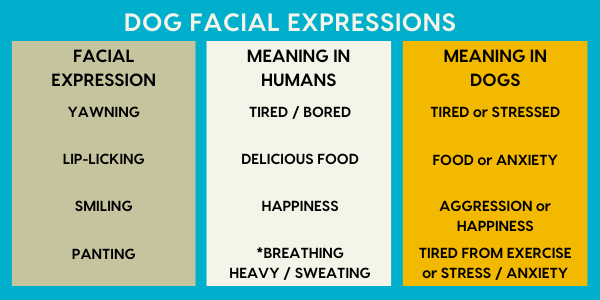
The mouth can be a harder aspect of body language to read since it is more subtle, but still equally as important. A loose, open mouth signals contentment, whereas a tight, closed mouth might indicate tension. If you see lip licking if there’s no food around, this can be a sign of anxiety.
Dogs may also “smile,” but context matters, a relaxed posture with slightly bared teeth might be playful, but paired with a stiff body and growl is a clear warning. Panting can also be an indicator of stress. Of course it is normal for dogs to pant when hot or after exercise, but unprovoked panting paired with other signs of stress may indicate your dog is feeling anxiety.
Growling is also part of how dogs communicate and should not be punished. A play growl paired with a wiggly, loose body usually means excitement and fun, while a growl with a stiff body is a warning to give them space.
- Loose open mouth = relaxed
- Tight closed mouth = tension
- Lip licking (no food present) = stress signal
- Growling with lip lift = warning
- Play growl with loose body = excitement
Understanding your dog’s facial expressions is like learning a new language. Once you notice the eyes, ears, and mouth in context with the rest of their body, you’ll start catching the tiny cues that make all the difference in keeping your pup happy, confident, and safe.
Vocalizations
While much of dog communication is visual, sound is an important way they reinforce what their bodies are already saying. Barking, growling, whining, and other vocalizations provide extra context and can help you understand how your dog is feeling in the moment, but it’s rarely about the noise alone. Tone, pitch, and posture matter just as much as the sound itself.
Barking: Excitement, Alert, or Attention-Seeking?
Barking is perhaps the most recognizable dog sound, but it’s also the easiest to misinterpret. A high-pitched, rapid bark often signals excitement, think of a dog greeting you after you’ve been gone all day. It’s a happy, energetic sound meant to grab attention and invite engagement.
A deep, repetitive bark, on the other hand, can be a warning. When paired with a stiff body, direct stare, or raised hackles, it’s a clear “stay back” message, your dog is uncomfortable or unsure and is communicating boundaries.
Sometimes dogs emit short, playful barks during games of chase or tug. These are usually paired with loose, wiggly bodies and wagging tails. Context is everything: the same bark could be excitement, play, or alert, depending on your dog’s posture and what’s happening around them.
🦴Related Reading: My Dog Barks at Everything! Here's How to Stop Dog Barking | Pupford
Growling: Communication, Not Defiance
Growling is another misunderstood sound. Many people assume it’s always aggression, but growls are actually a form of communication, a way for your dog to say, “I am uncomfortable.”
A play growl will often come with a loose, bouncy body, wagging tail, or playful pounce. It’s part of a fun, interactive game, nothing to worry about.
A warning growl, however, is usually paired with a stiff stance, fixed gaze, and raised hackles. This growl is a cautionary signal that you should pay attention to before things escalate. Suppressing these warning growls through punishment can be dangerous, because it removes the dog’s ability to communicate discomfort safely.
Whining and Whimpering
Whines and whimpers are subtle, high-pitched sounds that can mean many things depending on context. Sometimes your dog is asking for attention or signaling they want to be closer to you. Other times, whining may indicate stress, frustration, or even physical pain.
To understand what a whine means, consider the situation and body language: Is your dog pacing anxiously, ears pinned back, tail low? Are they softly nudging you with their nose while wagging their tail? Both could involve whines, but the meanings are very different.
Recap: How to Read Dog Body Language
Understanding your dog’s body language is like learning a new language, one that is constantly spoken through tails, ears, eyes, mouths, posture, and even subtle vocalizations.
Every movement and expression tells a story, from playful bows and wagging tails to lip licks, whale eye, or raised hackles. By paying attention to the whole dog and the context of each signal, you can prevent misunderstandings, reduce stress, improve training, and build a deeper, more trusting bond with your pup.
The more you practice reading these cues, the more confident and connected you’ll feel, creating a relationship where your dog feels safe, understood, and valued, and where communication is truly a two-way street.
💡Ready to take your learning to the next level? Check out our Dog Body Language Course
You'll get:
- Video breakdowns of the most common dog body language signals
- Pictures and videos depicting their common body language signs
- A PDF 'cheat sheet' to help you understand and remember all dog language
- In-depth breakdowns of what you need to know about dog body language


