


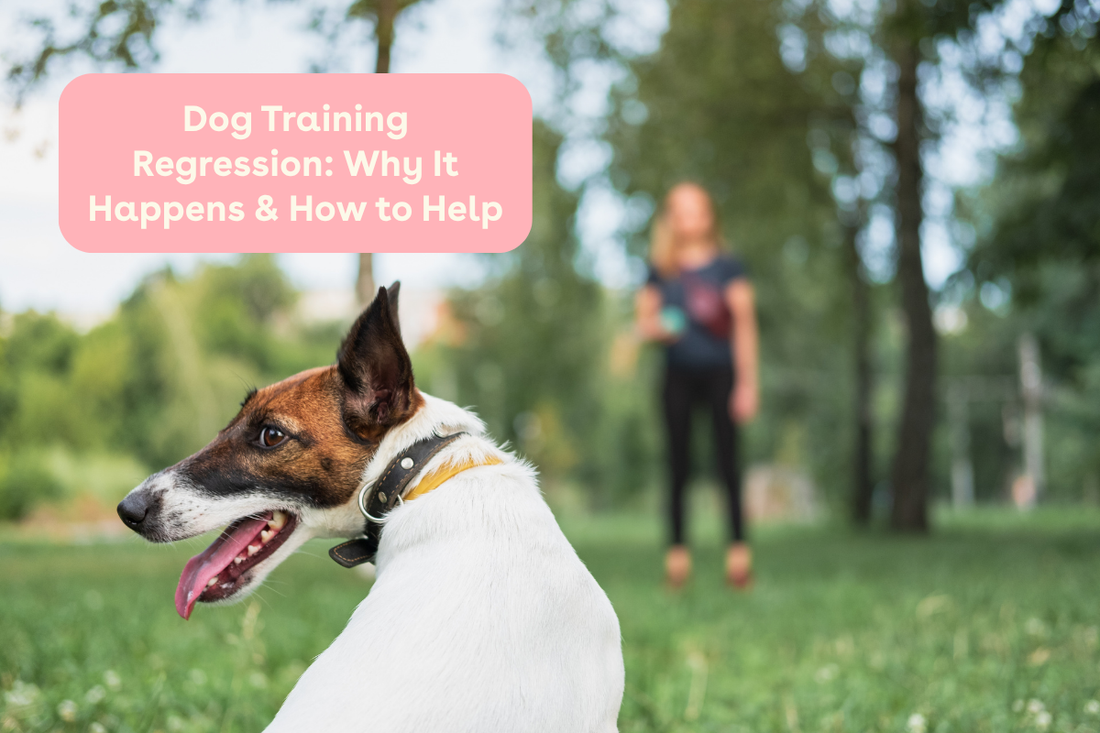
Have you ever felt like your dog suddenly forgot everything you've taught them? Maybe they stopped coming when called, started pulling on the leash again, or began having accidents after weeks of success. These unexpected setbacks can be frustrating, but they're also incredibly common. In many cases, what you're seeing is dog training regression, a temporary step backward in your dog's learning process.
The good news is that regression doesn't mean your dog has forgotten their training or that you've failed as a trainer. Just like people, dogs learn in stages, and it's normal for them to have periods where previously learned skills become less reliable. Understanding why dog training regression happens can help you respond with patience, adjust your training plan, and get your pup back on track.
In this article, we'll explain what regression in dog training is, why it happens, the most common causes, and practical, positive reinforcement-based strategies to help your dog regain confidence and continue making progress.
What Is Regression in Dog Training?

One day your dog is responding perfectly to "sit," coming when called, and walking politely on a leash.
The next? It feels like they've forgotten everything you've worked so hard to teach.
If this sounds familiar, take a deep breath, your dog probably isn't forgetting their training. They're experiencing regression.
Dog training regression is a temporary setback in behaviors your dog previously knew or performed reliably. It doesn't mean your dog is stubborn (this is actually called anthropomorphism!), trying to be difficult, or intentionally ignoring you. More often, it's a sign that something in their environment, development, or routine has changed.
The truth is, training progress is rarely a straight line. Just like people learning a new skill, dogs have ups and downs along the way. The good news? With patience, consistency, and positive reinforcement, most dogs regain their skills and often come back even stronger.
What Does Dog Training Regression Look Like?
Regression can show up in many different ways.
Your dog might suddenly:
- Ignore cues they previously responded to consistently
- Pull on the leash after weeks of loose-leash walking 👉Loose Leash Walking Training: 5 Tips to Stop Pulling | Pupford
- Stop coming when called 👉How to Teach a Dog to Come When Called – Every Time | Pupford
- Have potty accidents after being house trained 👉Is Your Dog Regressing in Potty Training? How to Potty Train an Adult – Pupford
- Become more distracted during training 👉Tips for Training Dogs Around Distractions | Pupford
- Bark or react more than usual 👉Understanding Your Reactive Dog: Why There Are No Quick Fixes | Pupford
- Struggle to settle in familiar environments 👉Co-regulation for Dogs: How it Can Help Your Dog Relax | Pupford
These behaviors can be frustrating, but they're usually temporary.
Instead of asking, "Why is my dog being bad?" try asking:
"What has changed that could be making this harder for my dog?"
That small shift in perspective often leads to better solutions.
Why Do Dogs Regress in Training?

There isn't one single cause of regression. Usually, several factors combine to make previously learned behaviors less reliable.
1. Adolescence
One of the most common reasons for regression is adolescence.
Between about 6 and 18 months of age, many dogs experience significant physical, hormonal, and neurological changes. During this stage, impulse control often decreases while curiosity and independence increase.
Many pup parents worry they've "lost" all of their training, but this stage is incredibly normal.
Rather than starting over, continue reinforcing the skills your dog already knows while helping them navigate this exciting (and sometimes chaotic) stage of development.
🐶Surviving the Puppy Teenage Phase & Rebellious Stage | Pupford
2. Changes in Routine
Dogs thrive on predictability.
Even positive life changes can temporarily affect behavior, including:
- Moving to a new home 👉Moving With Dogs | Pupford
- Starting a new job
- A new family member 👉Preparing Your Dog for Major Life Changes | Pupford
- Vacation
- Kids going back to school 👉Helping Your Dog Cope With Changes In Routine | Pupford
- Visitors staying at your home
If your dog suddenly seems distracted or forgetful, they may simply be adjusting to a new routine.
❤️Do Dogs Like Routines? 5 Reasons Pups Crave Routines | Pupford
3. New Environments
Dogs don't automatically understand that a cue means the same thing everywhere.
Your dog may perform a perfect "sit" in your kitchen but struggle to do the same thing at a busy park.
This is because dogs need to generalize behaviors, meaning they must learn that a cue applies in many different environments, not just the place where they first learned it.
Practicing skills in new locations with gradually increasing distractions helps build reliability.
If you're building your dog's training foundation, the 30 Day Perfect Pup program walks you through teaching behaviors that become reliable in everyday life.
4. Stress or Big Emotions
Stress affects learning (for both humans and dogs).
Your dog may temporarily regress after:
- A veterinary visit
- Boarding
- Loud noises
- Construction near your home
- Holidays
- New pets
- Moving
When dogs feel overwhelmed, it becomes harder for them to focus and make good choices.
Sometimes the best thing you can do is temporarily lower your expectations while helping your dog feel safe and successful again.
Not sure how to tell if your dog is stressed? 👉 Signs of Stress in Dogs: 12 Body Language Signs & Symptoms – Pupford
5. Training Progressed Too Quickly
It's easy to accidentally ask for too much, too soon.
Maybe your dog mastered "stay" in the living room, so you immediately tried it at the park with squirrels running around.
Training becomes more difficult whenever you increase:
- Distance
- Duration
- Distractions
Instead of increasing all three at once, challenge only one at a time.
Here’s how to Master the 3 D's of Dog Training: Distance, Distraction, Duration | – Pupford
6. Inconsistent Reinforcement
Sometimes regression isn't about the dog, it’s about us (I know, I know but sometimes we really are the problem 🤷♀️)
Common examples include:
- Stopping treats too soon
- Practicing less frequently
- Different family members having different rules
- Accidentally rewarding behaviors you don't want
Consistency helps dogs understand exactly what earns reinforcement.
7. Physical Discomfort or Illness
If regression appears suddenly, especially in an adult dog who has been reliable for months or years, it may be worth scheduling a visit with your veterinarian.
Pain, injuries, gastrointestinal issues, urinary tract infections, or other medical conditions can all influence behavior.
Always rule out medical concerns if your dog's behavior changes dramatically.
How to Handle Dog Training Regression
The goal isn't to train harder.
It's to train smarter.
Go Back to Basics
Think of regression as a reminder to strengthen your foundation.
If your dog struggles with recall at the park, return to practicing inside your home or backyard before increasing distractions again.
🐕3 Things That Can Make The Biggest Improvements To a Dog's Behavior | – Pupford
Increase Reinforcement
When your dog makes good choices, reward them generously.
High-value rewards can help rebuild motivation and remind your dog that listening pays off.
❤️The Best Freeze-Dried Dog Training Treats for Effective Training – Pupford
Don't worry that you're "spoiling" your dog by using treats. Rewards strengthen behaviors you want to see more often.
Keep Sessions Short
Aim for training sessions that last 3–5 minutes.
Short, frequent sessions are more effective than long sessions that leave either you or your dog frustrated.
Always try to end on a success.
Meet Your Dog's Needs
Many training setbacks improve when dogs receive enough:
- Physical exercise
- Mental enrichment
- Rest
- Opportunities to sniff and explore
A fulfilled dog is often much better able to focus during training.
Looking for easy enrichment ideas? Check out our guide to Mental Enrichment for Dogs for simple games and activities you can do at home.
Stay Consistent
Consistency creates clarity.
Use the same verbal cues, reward the behaviors you want, and make sure everyone in your household follows the same expectations.
If you'd like additional support, the Pupford Academy offers step-by-step training plans to help you stay consistent and build lasting behaviors.
Avoid Punishment
Punishment often increases stress and makes learning more difficult.
Instead, focus on setting your dog up for success and reinforcing the behaviors you'd like to see more often.
Positive reinforcement helps dogs feel confident while strengthening the bond you share.
👉Are You Unknowingly Using Aversive Training Techniques?
How Long Does Regression Last?

Every dog is different.
Some regressions last only a few days, while others, especially during adolescence, may come and go for several weeks or months.
Rather than focusing on one difficult training session, look for overall progress over time.
Ask yourself:
- Is my dog recovering more quickly?
- Are mistakes becoming less frequent?
- Is focus gradually improving?
If the answer is yes, you're moving in the right direction.
When Should You Get Professional Help?
Most cases of regression improve with consistency and patience.
However, it's worth working with a qualified positive reinforcement trainer if:
- Regression continues despite regular practice
- Your dog develops fear or aggression
- Reactivity suddenly worsens
- Your dog appears anxious or distressed
- You're unsure why behavior changed
If behavior changes seem sudden or severe, talk with your veterinarian. In some cases, a board-certified veterinary behaviorist can help identify underlying medical or behavioral causes.
🐶How to Choose the Right Dog Trainer | Pupford
Frequently Asked Questions

Is regression normal in dog training?
Yes. Regression is a completely normal part of learning. Many dogs experience temporary setbacks due to adolescence, changes in routine, stress, or new environments.
Why is my dog suddenly ignoring cues?
Your dog probably hasn't forgotten their training. They may be distracted, stressed, adjusting to a new environment, or going through a developmental stage like adolescence.
Should I start over if my dog regresses?
Usually not. Instead, return to easier versions of the behavior, increase reinforcement, and gradually build back up.
Can older dogs experience training regression?
Absolutely. Adult and senior dogs can regress due to stress, routine changes, reduced practice, aging, or underlying medical conditions. If the change is sudden, consult your veterinarian.
Recap: Dog Training Regression
Regression can feel discouraging, but it's a normal part of your dog's learning journey, not a sign that your training isn't working. Every setback is an opportunity to strengthen the foundation you've already built. By staying patient, keeping training sessions positive, and rewarding the behaviors you want to see, you'll help your dog regain confidence and continue making steady progress.
Remember, training isn't about achieving perfection overnight. It's about building a lifelong relationship based on trust, communication, and consistency. Celebrate the small wins, adjust your expectations when needed, and know that every successful repetition moves your dog one step closer to becoming a confident, well-mannered companion.
If you're looking for extra support, explore Pupford Academy for step-by-step training guidance, stock up on Pupford Training Treats to keep your dog motivated, or browse our library of training articles for more positive reinforcement tips.
With the right tools and a little patience, you and your pup can work through regression together, and come out even stronger on the other side.


