


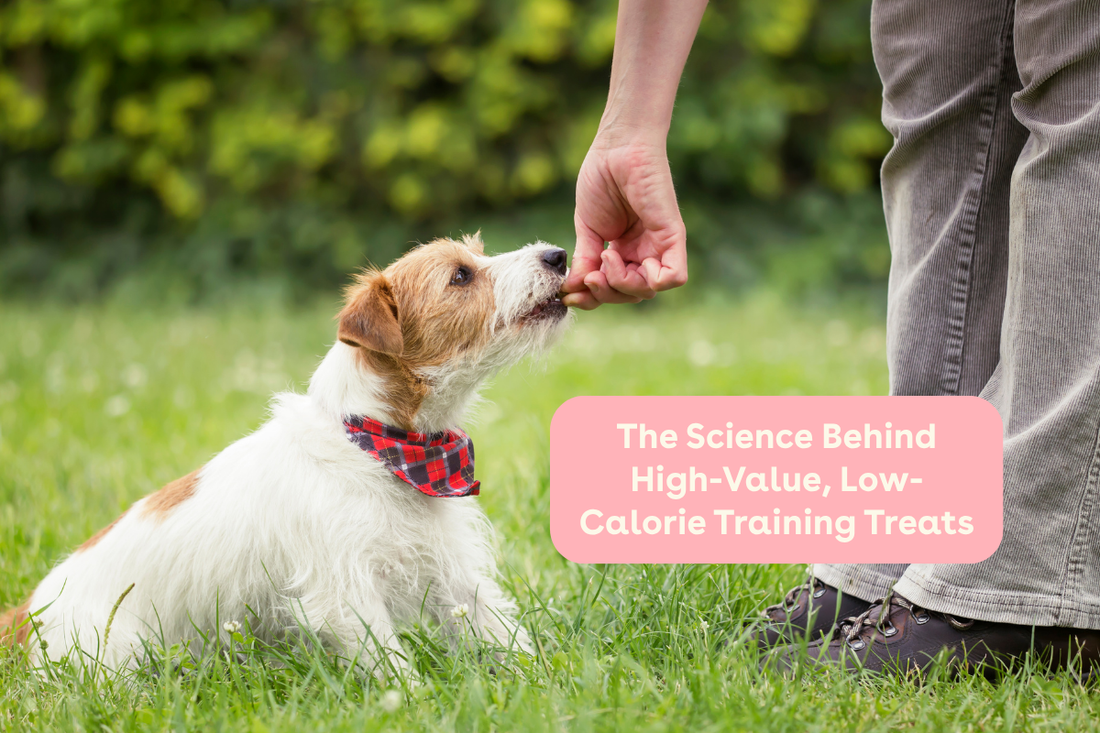
When it comes to training your dog, timing, consistency, and rewards all matter. But not all rewards are created equal.
If you've ever struggled to keep your dog's attention during training, found your dog losing interest after a few repetitions, or worried about giving too many treats, you're not alone. One of the most overlooked aspects of successful dog training is choosing the right reward.
That's where high-value, low-calorie training treats come in.
The best training treats are motivating enough to keep your dog engaged while being small and healthy enough to use frequently. Understanding the science behind why these treats work can help you become a more effective trainer and help your dog learn faster.
Let's break down the science of reinforcement, what makes a treat "high value," why calories matter, and how Pupford Training Treats are designed to support better training outcomes.
Why Rewards Matter in Dog Training

Modern dog training relies heavily on positive reinforcement.
Positive reinforcement simply means adding something your dog enjoys immediately after a behavior, making that behavior more likely to happen again in the future.
For example:
- Your dog sits.
- You give them a treat.
- Sitting becomes more likely in the future.
This concept comes from operant conditioning, a learning theory developed by psychologist B.F. Skinner. Research has consistently shown that behaviors followed by rewarding consequences are more likely to be repeated.
The reward serves as information. It tells your dog:
"Yes, that's exactly what I wanted."
The stronger and more meaningful the reward is to your dog, the more effective that reinforcement becomes.
This is why reward selection matters.
What Makes a Treat "High Value"?

A high-value treat is simply a reward your dog finds highly motivating.
Think about it this way: if someone offered you a plain cracker or your favorite dessert, which would motivate you more?
Dogs make similar decisions.
While every dog is different, high-value treats often share a few characteristics:
Strong Smell
Dogs experience the world primarily through their noses.
A dog's sense of smell is estimated to be tens of thousands of times more sensitive than ours. Because scent plays such an important role in how dogs evaluate food, treats with a strong aroma tend to be more enticing.
🐶Are You Using Your Dog's Nose Enough? How to Encourage Your Dog's Senses – Pupford
This is one reason freeze-dried treats are often highly motivating. The freeze-drying process helps preserve natural flavors and scents that dogs love.
High Protein Content
Many dogs naturally gravitate toward meat-based rewards.
Protein-rich treats often provide a stronger reinforcement value than treats filled with sugars, fillers, or artificial ingredients.
💖10 Ingredients to Avoid in Dog Food & Treats + Safe Alternatives | Pupford
Single-ingredient meat treats can be especially appealing because they closely resemble foods dogs are biologically adapted to seek out.
Easy to Eat
Training sessions move quickly.
If your dog spends 30 seconds chewing every reward, momentum disappears.
High-value training treats should be:
- Small
- Quick to consume
- Easy to swallow
- Convenient to deliver
The faster your dog can eat the reward, the faster you can continue training.
Novelty
Sometimes value comes from rarity.
Many trainers reserve their highest-value treats for difficult situations, such as:
- Recall training
- Reactive dog training
- High-distraction environments
- Prey drive
When a reward isn't available all the time, it can become even more motivating.
The Dopamine Connection

One of the reasons rewards are so effective in dog training is that they activate the brain's reward system. When a dog anticipates or receives something they find valuable, their brain releases dopamine.
While dopamine is often referred to as the "feel-good" neurotransmitter, its role goes far beyond creating pleasure. Dopamine plays a key role in motivation, learning, and reinforcing behaviors. It helps the brain recognize which actions lead to positive outcomes and encourages those actions to be repeated.
When a training session follows a simple pattern, your dog performs a behavior, receives a reward, and experiences a positive outcome, the brain begins to strengthen the neural pathways associated with that behavior. With repeated practice and reinforcement, those pathways become stronger and more efficient.
Over time, behaviors that are consistently rewarded become easier and more automatic. In other words, they start to become habits.
This is why the quality of the reward matters. The more meaningful and motivating the reward is to your dog, the more likely they are to repeat the behavior that earned it. That's why finding a treat your dog truly loves can have such a significant impact on training success.
Why Low-Calorie Treats Matter

Many dog guardians understand the importance of rewarding frequently.
What they don't always consider is the calorie impact.
During an active training session, it's common to deliver dozens of rewards.
Consider:
- Practicing recall for 10 minutes
- Working on loose leash walking
- Teaching a new trick
- Reinforcing calm behavior around distractions
Your dog might receive 30, 50, or even 100 rewards in a single day.
If each reward contains several calories, those numbers add up quickly.
The Hidden Cost of Large Treats
Many treats marketed as "training treats" are surprisingly large.
Some contain:
- Excess fillers
- Added sugars
- Artificial ingredients
- Unnecessary calories
Using high-calorie treats regularly can contribute to:
- Weight gain
- Reduced training frequency
- Digestive upset
- Imbalanced nutrition
According to veterinary experts, treats should generally make up no more than about 10% of a dog's daily caloric intake.
🐕Treat Truth: The Sneaky Side of Calories in Dog Treats | Pupford
This creates a challenge:
How do you reward often without overfeeding? The answer is low-calorie training treats.
👉How Many Treats Per Day for a Dog? How to Calculate for Your Pup! | Pupford
Why Small Treats Improve Learning

One common misconception is that bigger rewards always mean better training.
In reality, frequency often matters more than size.
Research on reinforcement suggests that immediate and consistent rewards are critical for learning.
Small treats provide several advantages:
More Repetitions
Smaller rewards allow you to reinforce more behaviors without exceeding calorie goals.
More repetitions create more learning opportunities.
Faster Delivery
A tiny reward can be delivered instantly.
Timing is one of the most important aspects of effective training. The closer the reward is to the desired behavior, the stronger the learning connection becomes.
Better Focus
Large treats can interrupt training sessions.
Small treats keep dogs engaged and ready for the next repetition.
Longer Training Sessions
Because you're using fewer calories, you can train longer and more often.
Consistent practice is what drives long-term behavior change.
The Freeze-Dried Advantage

Not all treats are created equally.
Freeze-drying has become increasingly popular among trainers because it helps preserve many of the qualities dogs find rewarding.
The freeze-drying process removes moisture while maintaining much of the food's natural:
- Flavor
- Aroma
- Nutritional value
This creates a highly palatable reward without requiring artificial preservatives or fillers.
For dogs, this often means:
- Better taste
- Stronger scent
- Higher motivation
For pup parents, it means a simple ingredient list and a reward that can be carried virtually anywhere.
🐶The Best Freeze-Dried Dog Training Treats for Effective Training – Pupford
What Trainers Look for in a Training Treat

Professional trainers often evaluate treats using a few key criteria.
A great training treat should be:
High Value
The dog should actively want it.
Low Calorie
The treat should support frequent reinforcement.
Easy to Carry
Treats should fit easily in a pocket or treat pouch.
Non-Crumbly
Nobody wants a pouch full of crumbs.
Minimal Ingredients
Simple ingredient lists can be especially helpful for dogs with food sensitivities.
Consistent Size
Uniform pieces help create predictable rewards and cleaner training sessions.
Why Pupford Training Treats Were Designed Differently

At Pupford, we believe training should be simple, rewarding, and accessible to everyone.
That's why Pupford Freeze-Dried Training Treats were specifically designed with training science in mind.
Instead of creating a treat that's too large, too messy, or too calorie-dense, Pupford focuses on what dogs and trainers actually need.
Only 1 Calorie Per Treat
One of the biggest advantages of Pupford Training Treats is that each treat contains only about 1 calorie.
This allows you to reward frequently without worrying about excessive calorie intake.
High-Value Protein
Pupford Training Treats are made with simple, high-quality ingredients dogs love like beef, chicken, rabbit, and salmon.
The freeze-dried process helps preserve the natural flavor and aroma that make treats highly motivating.
Many dogs find these rewards exciting enough to stay engaged even in distracting environments.
Perfect Training Size
Each treat is small and easy to consume. No lengthy chewing. No interruptions.
Just quick rewards that keep training sessions flowing smoothly.
Clean Ingredients
Pupford's commitment to simple ingredients means you know exactly what you're feeding your dog.
No unnecessary fillers. No artificial junk.
Just straightforward rewards designed to support effective training.
Less Mess
Many training treats leave greasy residue on hands, pockets, or treat pouches.
Pupford Training Treats are lightweight, easy to carry, and far less messy than many alternatives.
That means more focus on training and less cleanup afterward.
When Should You Use High-Value Training Treats?

High-value rewards can be used every day, but they're especially helpful when teaching difficult skills.
Consider using higher-value rewards during:
Recall Training
Coming when called is one of the most important behaviors a dog can learn.
A strong reward can help build a reliable response.
👉Take our Recall Mastery Course!
Training Around Distractions
Dogs often struggle when competing with:
- Other dogs
- Wildlife
- Visitors
- New environments
Higher-value rewards can help you stay relevant when distractions increase.
Reactive Dog Training
Many behavior modification plans rely on creating positive emotional associations.
High-value treats play an important role in that process.
💖Check out our Reactive Dog Course!
Puppy Training
Puppies are constantly learning.
Frequent reinforcement helps build desirable habits from the start.
Recap: The Science Behind High-Value, Low-Calorie Training Treats
The science is clear: rewards drive learning.
But the most effective rewards aren't necessarily the biggest treats. They're the treats that balance motivation, nutrition, convenience, and frequency.
High-value, low-calorie training treats allow you to reward more often, maintain better timing, and build stronger behaviors over time.
Whether you're raising a puppy, refining obedience skills, working through distractions, or strengthening your bond with your dog, the right reward can make all the difference.
And that's exactly why so many trainers and pup parents choose Pupford Training Treats as their go-to training reward.


