


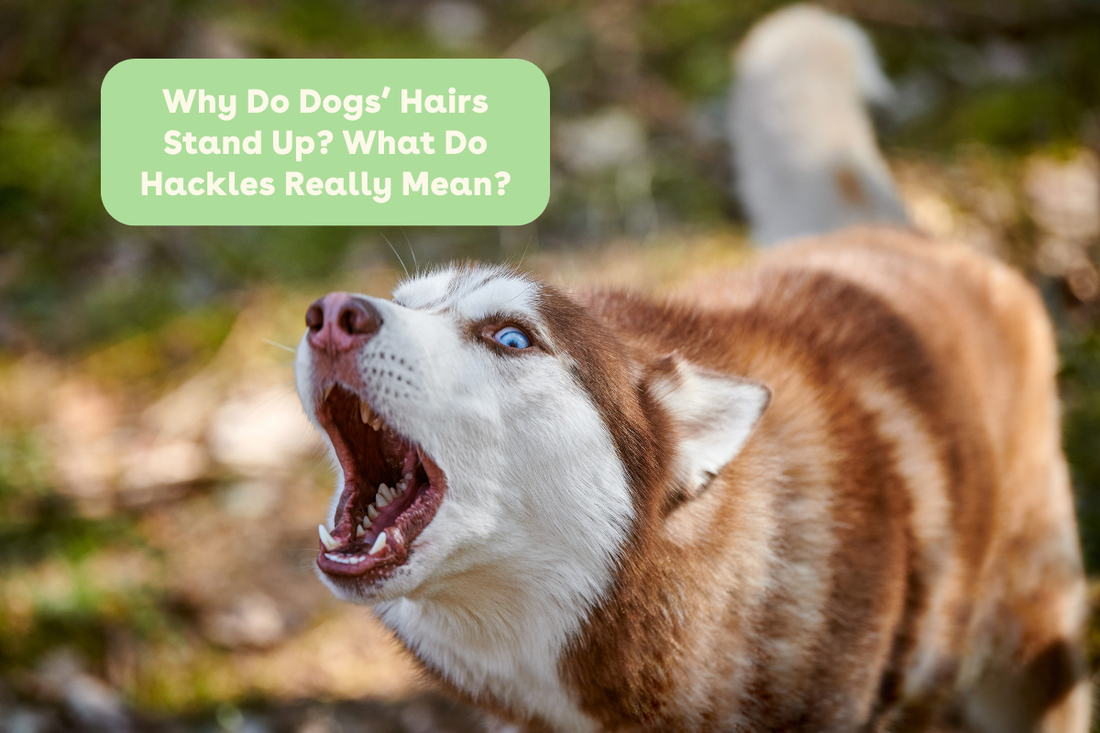
If you’ve ever seen the fur along your dog’s back suddenly stand straight up, you’ve witnessed something commonly called “raised hackles.” It can look dramatic (sometimes even intimidating), but what does it actually mean?
Are raised hackles a sign of aggression? Fear? Excitement? Protection?
The truth is, hackles are simply a physiological response, not a personality trait or a guarantee of behavior. Understanding what’s really happening when your dog’s hair stands up can help you read their body language more accurately and respond in a way that supports their emotional wellbeing.
Let’s break it down.
Table of Contents:
- What Are Hackles?
- Why Do Dogs’ Hairs Stand Up?
- Do Raised Hackles Always Mean Aggression?
- The Science Behind Raised Hackles
- What Raised Hackles Can Mean (Context Matters)
- Can Some Dogs Raise Hackles More Than Others?
- What Should You Do if Your Dog’s Hackles Rise?
- Common Misconceptions About Hackles
What Are Hackles?

Hackles refer to the strip of fur that runs along a dog’s spine, from the back of the neck down to the base of the tail. When those hairs lift or “stand up,” the technical term is piloerection.
Piloerection happens when tiny muscles at the base of each hair follicle contract, causing the hair to rise. This reaction is controlled by the autonomic nervous system, which means your dog doesn’t consciously decide to raise their hackles.
It’s automatic, like goosebumps in humans.
In other words:
Your dog is not “choosing” to raise their hackles. Their body is responding to an emotional or environmental stimulus.
Why Do Dogs’ Hairs Stand Up?

Raised hackles are part of your dog’s fight-or-flight response. When your dog experiences a surge of adrenaline, their nervous system activates, preparing them to respond to something important.
That “something” could be:
- Fear
- Uncertainty
- Excitement
- Frustration
- A perceived threat
- Sudden arousal (positive or negative)
The raised fur makes the dog appear larger, which can be useful in intimidating threats or signaling discomfort. It’s an evolutionary trait shared with many mammals.
But here’s the important part:
Hackles tell you your dog is emotionally aroused, not whether that emotion is good or bad.
Do Raised Hackles Always Mean Aggression?

No.
This is one of the biggest misconceptions about raised hackles.
Many pup parents assume that when a dog’s hair stands up, aggression is about to follow. While raised hackles can occur during aggressive displays, they are not a reliable predictor of aggression on their own.
Think of hackles as an emotional volume knob being turned up.
The dog may be:
- Nervous about a new environment
- Overstimulated during play
- Surprised by a sudden noise
- Frustrated by a barrier (like a fence or leash)
- Highly excited to greet another dog
Without looking at the rest of the body language, hackles don’t tell the full story.
🐶Learn about the Canine Ladder of Aggression!
The Science Behind Raised Hackles

When your dog perceives something significant, their sympathetic nervous system activates. This triggers a cascade of physiological changes:
- Increased heart rate
- Dilated pupils
- Muscle tension
- Heightened alertness
- Piloerection (raised hackles)
This is the same system responsible for survival responses. It prepares the body to act quickly.
The tiny muscles responsible for lifting the hair are called arrector pili muscles. They contract involuntarily when adrenaline levels rise.
This means hackles are a body response to emotional intensity, not a behavior your dog is performing intentionally.
What Raised Hackles Can Mean (Context Matters)

Because hackles reflect arousal, the meaning depends heavily on the situation and accompanying signals.
Let’s look at common scenarios.
1. Fear or Uncertainty
If your dog’s hackles rise while:
- Their body is stiff
- Their tail is tucked or low
- Their ears are pinned back
- They’re avoiding eye contact
This likely indicates fear or insecurity.
In this case, your dog may feel overwhelmed or unsure. They aren’t necessarily looking to start a conflict, they may simply be trying to assess a situation.
💖Learn about the spectrum of fear, anxiety, and stress in dogs
2. Defensive Posturing
If hackles are raised along with:
- Hard staring
- A tense body
- Growling
- Freezing
This could indicate defensive aggression.
Here, the dog is communicating discomfort and asking for space. The raised hackles amplify their visual presence.
💡Related Reading: Dog Aggression Basics with Karen Chapdelaine CPDT-KA | Pupford
3. Overstimulation During Play
Some dogs raise their hackles during high-energy play.
If you see:
- Play bows
- Loose, bouncy movement
- Relaxed facial expressions
- Pauses in play
The hackles may simply reflect excitement and adrenaline.
This is especially common in herding breeds or high-drive dogs.
4. Leash Reactivity
A dog on leash who sees another dog may raise their hackles due to frustration or fear, not aggression.
If the dog:
- Pulls forward
- Whines or barks
- Appears conflicted
- Strains against the leash
- Barks
- Lunges
- Bares teeth
The raised hackles may reflect high arousal combined with limited access.
This is why understanding emotional states is so important in reactivity training.
🐕Do you have a leash reactive dog? Check out our Reactive Dog Course
Can Some Dogs Raise Hackles More Than Others?

Yes.
Some dogs have more pronounced piloerection due to coat type or breed genetics. Dogs with thicker coats or longer fur along the spine may show more dramatic hackle raising.
Additionally, some dogs are simply more sensitive to environmental stimuli. A dog with a lower stress threshold may display raised hackles more frequently because their nervous system activates more easily.
This doesn’t mean they’re aggressive. It often means they’re more emotionally reactive.
🦴Related Reading: Signs of Stress in Dogs: 12 Body Language Signs & Symptoms – Pupford
What Should You Do If Your Dog’s Hackles Rise?

First: stay calm.
Remember, this is an automatic response. Your dog isn’t “misbehaving.”
Next, assess the situation and ask yourself:
- What just happened?
- What is your dog looking at?
- What does their overall body language suggest?
If your dog appears:
-
Fearful → Create space and reduce pressure.
-
Overstimulated → Pause and allow decompression.
-
Defensive → Safely increase distance from the trigger.
- Excited → Redirect into a structured activity.
Because hackles are involuntary, correcting your dog for raised fur would be like correcting someone for having goosebumps.
Instead, focus on helping your dog regulate their emotional state and work on training to teach your dog how to stay emotionally regulated in moments of high arousal.
💖Over-Arousal in Dogs: What It Is, Why It Happens & What to Do | Pupford
Hackles and Positive Reinforcement Training

Understanding hackles is especially important when using positive reinforcement methods.
When a dog is in a high state of arousal, learning becomes more difficult. The thinking part of the brain (the cortex) is less accessible when the survival system is activated.
If your dog frequently raises their hackles around certain triggers, this may signal that:
- They need gradual exposure (desensitization)
- They need counter-conditioning
- The training environment may be too intense
Rather than labeling the dog as reactive or aggressive, view hackles as feedback.
They’re information.
And information helps you build a better training plan.
🐶Counterconditioning & Dog Desensitization Training Guide | Pupford
Common Misconceptions About Hackles

Let’s clear up a few myths.
Myth 1: Raised hackles mean a dog is about to attack.
Not true. Hackles indicate arousal, not intent.
Myth 2: Only aggressive dogs raise their hackles.
False. Fearful, playful, and excited dogs can all experience piloerection.
Myth 3: A confident dog never raises their hackles.
Even stable, well-socialized dogs can raise their hackles in novel or intense situations.
Myth 4: You should correct a dog for raising their hackles.
Because it’s involuntary, correction doesn’t address the root cause and can increase stress.
How Hackles Relate to Stress Signals
Raised hackles often accompany other subtle stress signals, including:
Lip licking

Yawning

Turning away

Paw lifting

Whale eye (seeing the whites of the eyes)

When these signals appear together, your dog is likely communicating discomfort.
💡Learn to spot early signals so you can help intervene before arousal escalates in our Body Language Course
Recap: What Do Hackles Really Mean?
Hackles Are Communication
Raised hackles are a visible reminder that dogs experience complex emotional states. When your dog’s hair stands up, they aren’t trying to dominate, challenge, or intimidate you, they’re responding to something in their environment. Their nervous system has activated, and their body is preparing to process or respond to a situation.
So when you see hackles rise, shift your internal dialogue to: “My dog is feeling something strongly right now.”
That feeling might be excitement, uncertainty, frustration, or fear, but the raised fur itself simply tells you that emotional arousal is present.
Your role as a pup parent isn’t to suppress big emotions, but to help your dog navigate them safely. That might mean creating distance, redirecting focus, reinforcing calm behavior, or allowing time to decompress. With positive reinforcement and thoughtful exposure, your dog can build confidence and emotional regulation over time.
Hackles are communication, not conflict. They don’t automatically mean aggression or that your dog is “bad.” They’re simply one piece of the body language puzzle. When you respond with observation, empathy, and science-based training, you strengthen trust and support a more confident, secure dog.
🐶Ready to start training? Sign up for Pupford Academy+!


